 Govarna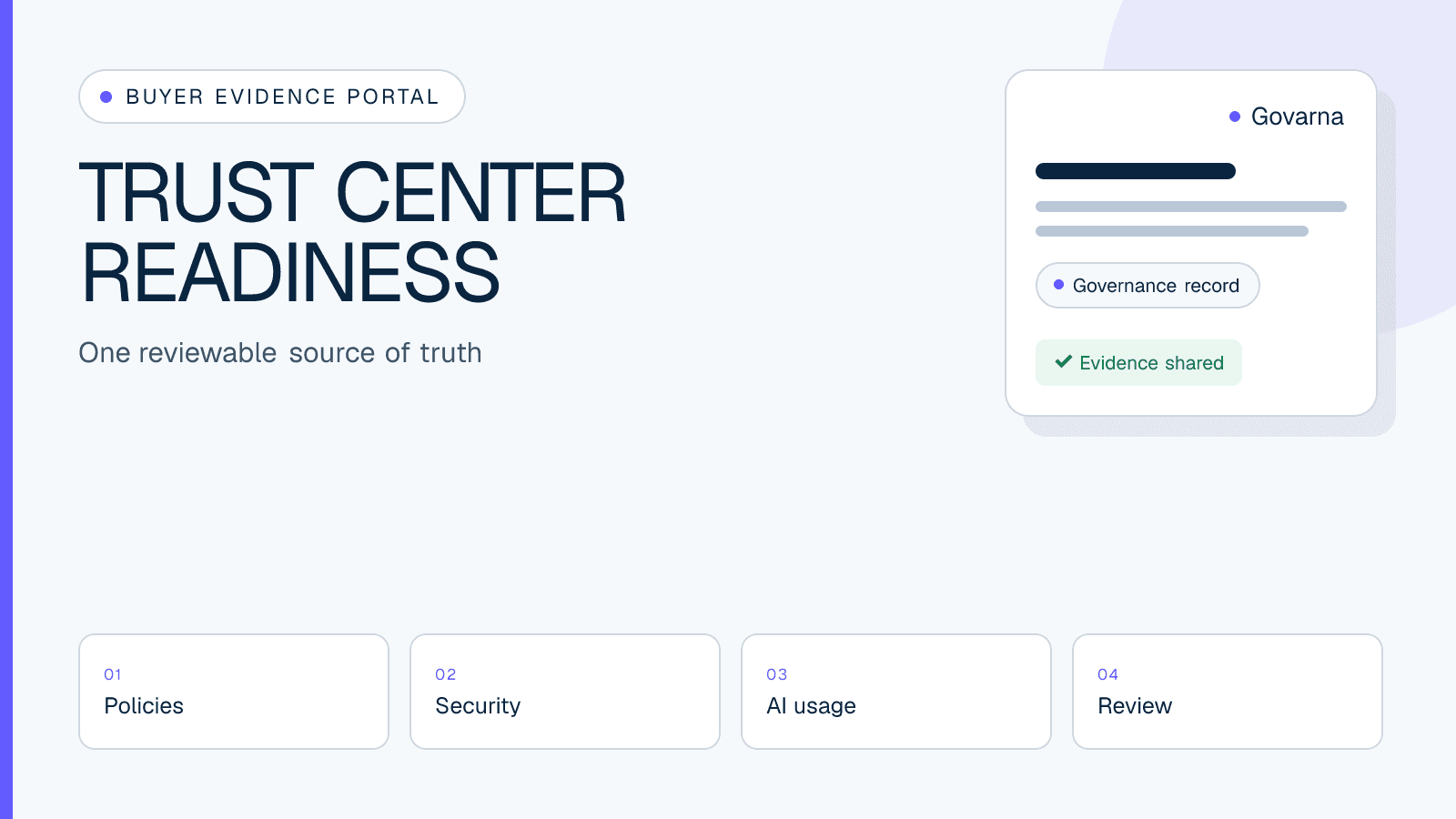
What is a trust center?
A trust center is a public, self-serve web page where a vendor publishes its security and compliance posture, certifications, subprocessor lists, data handling practices, security controls, AI transparency statements, and legal documents, so buyers can verify the vendor directly instead of extracting the same information through questionnaires and email threads. It is typically hosted at a URL like trust.yourcompany.com and maintained by the security or compliance team.
The contrast is with traditional, purely reactive procurement: a B2B SaaS company reaches the contract stage, the buyer sends a 150-question security questionnaire spreadsheet, and the vendor's security team spends days looking up details it has already answered for a dozen other buyers. A trust center flips this dynamic—you answer once, publicly and verifiably, and every subsequent review starts from that baseline.
Trust centers matured alongside SOC 2 as a B2B norm, but the AI wave has changed what buyers expect to find on them. A trust center without an AI transparency section now reads as incomplete to any buyer whose procurement checklist includes AI questions, which, in practice, is most of them.
How does a trust center reduce security review friction?
A trust center reduces friction by pre-answering the majority of a buyer's checklist before the questionnaire is sent, letting reviewers verify claims self-serve, and giving sales teams a single authoritative link to share, which together compress review cycles and cut repeated question rounds. It does not eliminate security review; it changes where the review starts.
- Pre-answering: Compliance officers at large enterprises review many vendors a month, and most work from a standard internal checklist. When your trust center maps cleanly onto that checklist, reviewers mark items verified without ever contacting you. Some buyers will accept a trust center link in place of entire questionnaire sections.
- Self-serve verification: A claim in a questionnaire is an assertion; the same claim on a public page with a last-updated date, a named certification, and a downloadable policy is evidence a reviewer can check independently, no meeting required.
- Sales enablement: When a prospect raises security in a sales call, "everything is at trust.ourcompany.com, including our AI policies and subprocessor list" is a complete answer available on day one of the evaluation—not week four. It also signals organizational maturity: vendors that publish their posture generally have one.
- Fewer question rounds: Most review delay comes not from the first questionnaire but from follow-up rounds triggered by vague or missing answers. A thorough trust center removes the ambiguity that generates those rounds.
Do trust centers replace security questionnaires?
No, a trust center shortens security questionnaires rather than replacing them: many buyers accept a trust center link in place of entire questionnaire sections, and some skip standard questionnaires for well-documented vendors, but regulated buyers will still send targeted questions and evidence requests that only a prepared answer bank can handle.
It helps to think of the two as layers of the same system. The trust center handles the generic layer—the questions every buyer asks in nearly identical words (Do you train on customer data? Who are your subprocessors? What certifications do you hold?). The questionnaire handles the specific layer—questions shaped by the buyer's industry, risk appetite, and intended use of your product. A financial services buyer evaluating your AI features for a regulated workflow will always have questions your trust center cannot pre-answer, because they depend on their deployment context.
The practical consequence: the strongest setup is a trust center and a questionnaire answer bank maintained from the same source of truth. The trust center absorbs the generic layer publicly; the answer bank makes the specific layer fast and, critically, consistent with what you have already published. Buyers who find the two in agreement tend to accept both; buyers who find them in conflict trust neither.
What should your trust center include?
A complete trust center covers seven sections, certifications, subprocessors, data handling, security controls, AI transparency, availability and incident history, and legal documents, each publishing verifiable facts with a visible last-updated date rather than marketing language. The table below maps each section to what you should publish and what reviewers actually check when they land on it.
| Trust Center Section | What to Publish | What Buyers Check |
|---|---|---|
| Certifications & Attestations | SOC 2 Type II status, ISO 27001, ISO 42001 if held; audit period dates; NDA-gated report download | Whether the audit period is current and whether the certified scope actually covers the product (and its AI features) |
| Subprocessor List | Every subprocessor with purpose, data categories, and location; change-notification signup | Parity with the DPA annex; whether AI/model vendors appear; how recently it changed |
| Data Handling & Privacy | Data residency, retention periods, deletion process, encryption at rest and in transit, tenant isolation model | Concrete numbers and mechanisms vs. vague assurances; consistency with the privacy policy |
| Security Controls Overview | Access control model, SSO/MFA support, vulnerability management, pen test cadence, secure development practices | Whether controls map to their checklist (often SIG- or CAIQ-derived); pen test recency |
| AI Transparency | Training-data statement, AI subprocessor list, AI feature inventory, human oversight controls, opt-out, EU AI Act posture | Consistency with marketing claims about AI features; whether model vendors match the subprocessor list |
| Availability & Incidents | Status page link, uptime commitment, incident response summary, security contact and disclosure policy | How past incidents were communicated; whether a responsible disclosure channel exists |
| Legal Documents | DPA, terms of service, SLA, acceptable use policies, current versions, self-serve | Whether the DPA subprocessor annex and AI clauses match everything else on the page |
The pattern in the right-hand column is worth internalizing: buyers use your trust center primarily as a consistency instrument. Every section is checked against some other artifact: the DPA, the SOC 2 scope, your marketing pages, your questionnaire answers. Publishing more content only helps if all of it agrees.
What belongs in the AI transparency section?
The AI transparency section should answer, in public, the questions that dominate AI security questionnaires: whether customer data trains models, which AI vendors process data and for which features, what human oversight exists, whether customers can opt out, and what your posture is under the EU AI Act. This is the section most trust centers still lack, and the one that most differentiates you in an AI-cautious procurement process.
- Model training statement: A clear, unqualified statement on whether customer production data is used to train your own or third-party models. If the answer has exceptions (e.g., explicit opt-in feedback data), state them precisely rather than omitting them.
- AI subprocessor list: A public index of your AI vendors with the specific features each powers and the retention configuration in force (for example, zero data retention under an enterprise agreement). This list must match your general subprocessor list and DPA annex exactly.
- AI feature inventory: A plain-language list of the AI-powered capabilities in your product. This mirrors the inventory-first structure of AI questionnaire addenda and anchors everything else on the page.
- Human oversight controls: How model outputs are reviewed before they matter: required approval steps for consequential actions, audit logging of AI outputs, and escalation paths when outputs are wrong.
- Customer opt-out: Whether and how an organization can disable AI features entirely, and whether deactivation is enforced server-side.
- Employee usage guidelines: Evidence that your own staff operate under an approved AI acceptable use policy, buyers increasingly ask about the vendor's internal AI hygiene, not just the product's.
- EU AI Act posture: Your role (provider, deployer, or both), the risk classification of your AI systems, and how you meet transparency obligations. If you haven't classified your systems yet, our free deployer assessment produces a classification in about 2 minutes.
Still fielding AI questionnaires the hard way?
Draft grounded, consistent answers from standard compliance baselines with our free questionnaire tool, then publish the same content to your trust center.
How do reviewers actually use your trust center?
Security reviewers use trust centers as a verification baseline: they check last-updated dates for staleness, compare the subprocessor list against your DPA annex, reconcile AI claims against your marketing pages, and cross-reference your questionnaire answers against what the trust center says. Understanding this workflow tells you where quality matters most.
- Freshness check first. A trust center whose sections were last updated a year ago—while your changelog shows a stream of new AI features—signals that the published posture no longer describes the product. Visible, recent per-section update dates are themselves a trust signal.
- Cross-artifact reconciliation. Reviewers open your trust center, DPA, and questionnaire responses side by side. Any divergence, an AI vendor named in one but not another, a retention period that differs between pages, generates a follow-up round, which is exactly the friction you built the trust center to avoid.
- Scope validation. Certification badges are checked against the underlying report's audit period and system boundary. A SOC 2 badge doesn't cover AI features shipped after the audit window, and reviewers know it.
- Gated-document requests. Reviewers expect full audit reports and pen test summaries behind a click-through NDA—that's normal. What frustrates them is gating basic policies and subprocessor lists that peers publish openly.
What should be public and what should be gated?
Publish policies, subprocessor lists, control summaries, and AI transparency statements openly; reserve NDA gating for genuinely sensitive artifacts such as full SOC 2 reports, penetration test results, and detailed architecture diagrams, and make even those available through a self-serve click-through rather than a sales conversation. The dividing line is whether the document would help an attacker or merely inform a buyer.
- Public by default: Training-data statement, AI subprocessor list, retention periods, certification status and audit dates, security control summaries, DPA, status page, disclosure policy. None of this is exploitable, and all of it is checked in every review.
- Click-through NDA: Full audit reports, pen test summaries, detailed data-flow and architecture diagrams, business continuity test results. Reviewers expect and accept this gate, provided access is instant and self-serve.
- Never a sales gate: Requiring a demo call or an account executive's approval to see any security document converts your trust center from a friction remover into a lead-capture form, and reviewers treat it accordingly.
What are the most common trust center mistakes?
The failure modes that turn a trust center from an accelerator into a liability are staleness, marketing language in place of verifiable facts, gating everything behind sales contact, contradictions with your other compliance artifacts, missing AI content, and implying certifications you don't hold.
- Staleness. The most common failure. Ship an AI feature, add an AI vendor, or change retention settings without updating the trust center, and the page becomes evidence against you in review. Assign an owner and tie updates to your release process.
- Marketing language instead of facts."We take security seriously" and "bank-grade encryption" verify nothing. Reviewers want nouns and numbers: TLS versions, retention periods, audit dates, vendor names.
- Gating everything. Requiring a sales call to see a subprocessor list recreates the friction the trust center exists to remove—and suggests the content wouldn't survive daylight.
- Contradicting your own artifacts. A trust center that disagrees with your DPA or your questionnaire answers is worse than no trust center: it proves your compliance program isn't internally coordinated.
- No AI section. If your product visibly ships AI features and the trust center is silent about them, reviewers assume the governance work hasn't been done and escalate to a full questionnaire.
- Implied certifications. Displaying framework logos (ISO 42001, SOC 2) in a way that implies certification you don't hold, or that covers scope it doesn't. If you're "aligned with" a framework rather than certified, say exactly that.
How do you launch a trust center?
Launching a trust center is an inventory-and-publish exercise: collect the artifacts you already have, write the AI transparency statements you're missing, publish them with per-section update dates, assign a named owner with an update cadence, and wire the URL into your sales process. A useful first version can go live in days, not quarters.
- Inventory existing artifacts. Certifications, DPA, subprocessor list, security policies, status page. Most companies have the majority of the content already, scattered across folders.
- Write the AI section. Use the checklist above. The training-data statement and AI subprocessor list are the two items buyers look for first.
- Choose hosting deliberately. A simple static page on your own domain is a legitimate first version, reviewers care about content and freshness, not polish. Dedicated trust center platforms add NDA click-through workflows, access analytics, and subprocessor change notifications; adopt one when those workflows start consuming real time.
- Publish with dates. Every section gets a visible last-updated date. Decide deliberately which documents are public and which sit behind a self-serve click-through NDA.
- Assign an owner and cadence. Trust center updates should be a standing item in your release process: new AI feature or vendor → trust center update before launch.
- Sync with your answer bank. Your trust center and your questionnaire answer bank must be generated from the same source of truth, or they will drift into the contradictions reviewers catch.
- Wire it into sales. Put the URL in outbound sequences, proposal templates, and your sales team's objection-handling playbook so it enters every deal early.
How do you know it's working? Watch three signals over the following quarters: the share of deals where the buyer accepts trust center links in place of questionnaire sections, the number of follow-up question rounds per review (the metric a trust center most directly reduces), and how often your own team has to research an answer from scratch rather than assembling it from published content. If none of these move, the usual cause is that the trust center isn't entering deals early enough, fix the sales wiring before adding more content.
How does the EU AI Act change what trust centers publish?
The EU AI Act turns AI transparency from a courtesy into a supply-chain requirement: buyers who deploy your AI features can qualify as deployers with obligations under Article 26, which they can only meet if you supply risk classifications, instructions for use, and transparency documentation, so they now expect to find your AI Act posture stated on your trust center.
The mechanics: Article 50 transparency obligations apply from August 2, 2026. Under the May 7, 2026 political agreement on the AI Omnibus, rules for systems in certain high-risk areas are scheduled for December 2, 2027 and product-integrated high-risk rules for August 2, 2028; these revised dates remain subject to completion of the legal adoption process. When the relevant high-risk rules apply, deployers must, among other Article 26 duties, assign competent human oversight and use systems in accordance with the provider's instructions. Violations of high-risk obligations carry fines up to EUR 15 million or 3% of global annual turnover (Article 99(4)); the higher EUR 35 million / 7% tier is reserved for prohibited practices (Article 99(3)). (Sources: European Commission AI Act overview; Regulation (EU) 2024/1689, EUR-Lex)
Practically, this means your trust center's AI section should state: whether any of your systems fall into Annex III high-risk categories, your role in the AI value chain (provider, deployer, or both), how Article 50 transparency is implemented in your product, and what documentation you make available to customers who are themselves deployers. For the full preparation sequence, see our EU AI Act compliance checklist.
Related resources
Build Your AI Trust Center Today
Govarna lets you publish a clean, hosted AI trust page displaying your approved policies, AI system inventory, and security credentials, kept in sync with your questionnaire answer bank.