 Govarna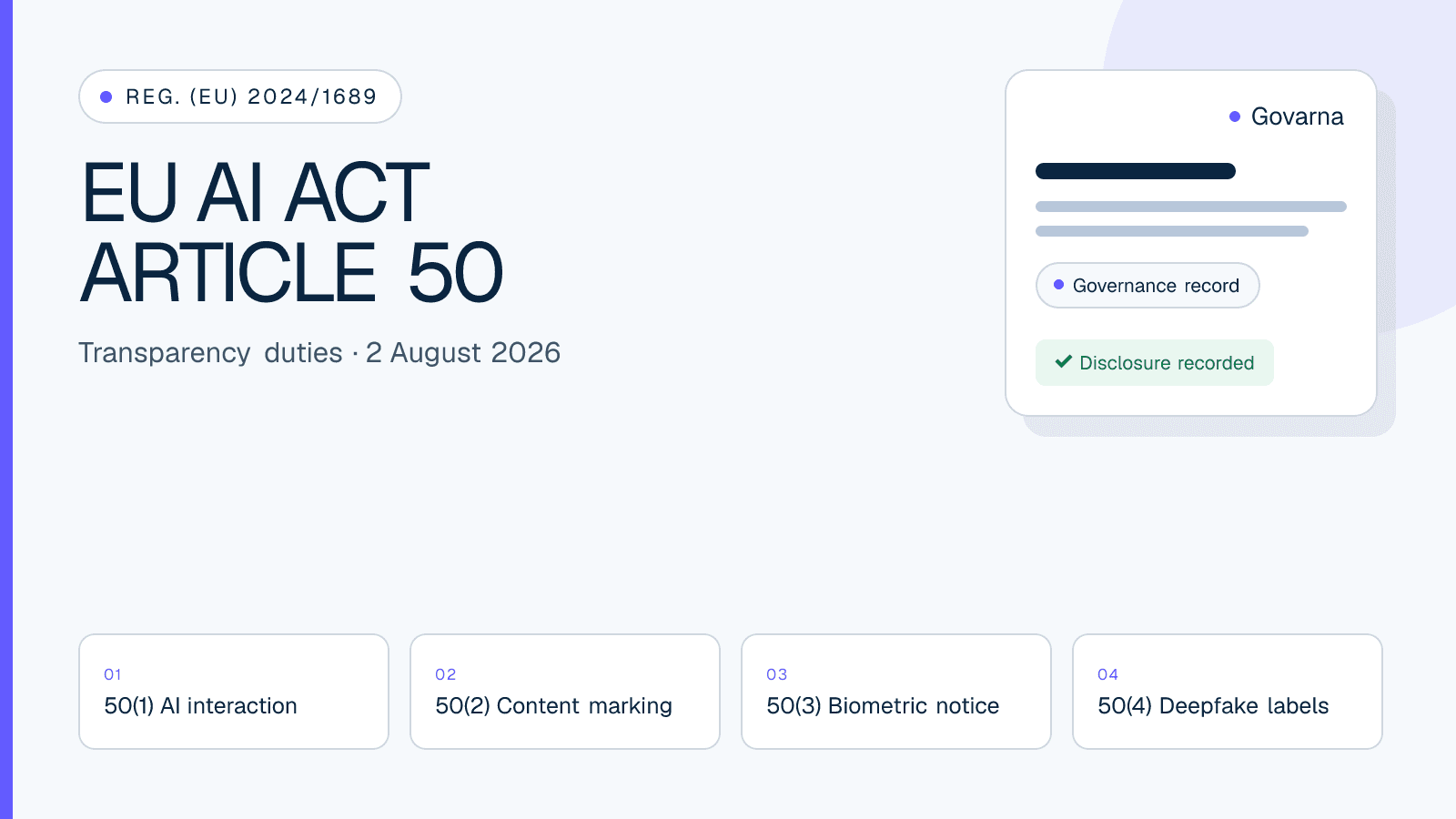
Article 50 of the EU AI Act creates transparency duties for providers and deployers of certain AI systems. In practical terms, people should be told when they interact with AI, synthetic content should carry machine-readable provenance where required, and specified biometric, deepfake, and public-interest uses require notices or labels.
This guide is written for B2B SaaS teams shipping chatbots, copilots, content-generation features, or biometric analysis to the EU market. It separates the four operative duties, identifies who is responsible, and turns the law into an implementation workflow.
What is Article 50 of the EU AI Act?
Article 50 is the transparency chapter of Regulation (EU) 2024/1689 for specified AI interactions and generated content. It applies beyond high-risk AI: an ordinary customer-support chatbot may trigger Article 50(1) even when it is not an Annex III high-risk system.
Scope still depends on the operator role. A provider develops or offers the AI system under its name; a deployer uses an AI system under its authority in a professional context. A SaaS company can hold different roles for different systems. Start with the EU AI Act compliance checklist for B2B SaaS rather than assuming that using a third-party model API determines the answer.
Authoritative text: Regulation (EU) 2024/1689 on EUR-Lex.
When does Article 50 apply?
| Date | Status and action |
|---|---|
| 27 July 2026 | Commission encouragement date for eligible providers and deployers wishing to sign the voluntary Code of Practice. |
| 2 August 2026 | Article 50 transparency duties become applicable. |
| 2 December 2026 | Proposed grandfathering date for specified existing generative systems under the AI Omnibus, if legally adopted. |
Do not treat the proposed transition as a general grace period. The Commission's Article 50 signing FAQ confirms that the main application date remains 2 August 2026.
The four Article 50 transparency duties
| Duty | Who | Requirement | SaaS example |
|---|---|---|---|
| 50(1) | Provider | Inform people when they interact directly with an AI system, unless this is obvious in context. | Customer-support chatbot or voice assistant |
| 50(2) | Provider | Mark synthetic audio, image, video, or text in a machine-readable and detectable format. | Image, video, voice, or text generation feature |
| 50(3) | Deployer | Inform people exposed to emotion-recognition or biometric-categorisation systems. | A feature inferring emotion from voice, face, or other biometric data |
| 50(4) | Deployer | Disclose deepfakes and certain AI-generated or manipulated public-interest text. | Synthetic video or unreviewed public-interest publication |
Article 50(1): direct AI interaction
Providers must design systems intended to interact directly with natural persons so those people are informed that they are interacting with AI, unless this is obvious to a reasonably well-informed, observant, and circumspect person in the circumstances. A persistent “AI Assistant” label plus an upfront first-interaction notice is more defensible than disclosure buried in terms.
Article 50(2): machine-readable content marking
Providers of systems generating synthetic audio, image, video, or text must mark outputs in a machine-readable format so they are detectable as artificially generated or manipulated. Measures must be effective, interoperable, robust, and reliable as far as technically feasible. Standard editing assistance that does not substantially alter input data or semantics is excluded.
For model-API features, document what the upstream provider supplies and what your product adds. Do not assume a foundation-model contract automatically satisfies the downstream feature's duty.
Article 50(3): emotion recognition and biometric categorisation
Deployers must inform natural persons exposed to emotion-recognition or biometric-categorisation systems and process personal data consistently with applicable data-protection law. Generic text sentiment analysis is not automatically emotion recognition: assess whether the system infers emotions or intentions from biometric data. Also check Article 5 first because specified workplace and education emotion-recognition uses are prohibited, subject to narrow exceptions.
Article 50(4): deepfakes and public-interest text
Deployers must clearly disclose qualifying deepfake image, audio, or video. AI-generated or manipulated text published to inform the public on matters of public interest also requires disclosure unless it underwent human review or editorial control and a person holds editorial responsibility. Artistic, satirical, fictional, and analogous works have tailored disclosure treatment.
Adaptable disclosure wording
The Act does not mandate a universal sentence. Treat these as drafting prompts for counsel and accessibility review, not approved legal language.
Chatbot label: “AI Assistant”
First message: “I'm [Product]'s AI assistant, not a human. You can ask to speak with a person at any time.”
Voice opening: “Hello, this is an AI assistant calling on behalf of [Company].”
Synthetic media: “AI-generated” displayed clearly on or next to the content, alongside required machine-readable marking.
Biometric notice: “This session uses AI to infer [specified signal]. See our privacy notice for how related data is processed: [link].”
Code of Practice and Commission guidelines
The Code of Practice on Transparency of AI-Generated Content, published 10 June 2026, supports Article 50(2), (4), and (5). It is voluntary. On 8 July 2026 the Commission and AI Board considered it an adequate compliance-support instrument, while emphasizing that adherence is not conclusive evidence of compliance.
The Commission's draft Article 50 guidelines, published 8 May 2026, address scope, definitions, exceptions, timing, accessibility, and areas outside the Code. Assign an owner to review the final guidance when published and record resulting decisions.
Penalties and commercial risk
Non-compliance with Article 50 can fall under Article 99(4), with maximum administrative fines of EUR 15 million or 3% of total worldwide annual turnover for the preceding financial year, subject to the Regulation's rules for undertakings and SMEs. More immediately, visible disclosure failures can create buyer-review and reputational risk. Avoid presenting a label alone as complete compliance: implementation, accessibility, role analysis, and records all matter.
10-step Article 50 implementation checklist
- Inventory covered features that interact with people, generate content, or use biometric signals.
- Record your role as provider, deployer, or both for each system.
- Check Article 5 first for prohibited biometric or emotion-recognition uses.
- Map each system to Article 50(1)–(4) and record why each duty applies or does not.
- Implement notices at the required time, including the first interaction or exposure where applicable.
- Verify technical marking supplied upstream and document product-level additions.
- Enable customer labelling workflows where your product generates content they may publish.
- Test accessibility and localization for every supported user channel.
- Version the decision record, implementation evidence, exceptions, and accountable owner.
- Track Commission guidance and review the system when facts, features, or law change.
Check your broader EU AI Act exposure
The free assessment provides a suggested provider/deployer and risk-exposure result, not a system-by-system Article 50 legal determination.
Run the free assessmentArticle 50 FAQ
Does Article 50 apply to US companies with no EU office?
It can. Article 2 covers providers placing AI systems on the EU market or putting them into service in the EU, and certain providers or deployers outside the EU where AI-system output is used in the EU. Scope depends on the company role and specific deployment.
Was Article 50 delayed in 2026?
No. The Article 50 transparency duties have applied since 2 August 2026. A proposed grandfathering rule would give certain existing generative AI systems until 2 December 2026 for specified marking duties if that Omnibus provision is legally adopted.
Do internal-only AI tools need a disclosure?
Article 50(1) can apply where an AI system interacts directly with employees or other natural persons unless the AI nature is obvious in context. A purely backend system with no direct human interaction is not caught by Article 50(1), though other obligations may apply.
Is the Code of Practice mandatory?
No. The Code of Practice on Transparency of AI-Generated Content is voluntary. The Commission considers it an adequate compliance-support instrument, but adherence is not conclusive proof of compliance.
Does grammar correction trigger machine-readable marking?
Article 50(2) excludes systems that perform assistive standard editing or do not substantially alter the input data or its semantics. Whether a feature meets that exception depends on what it actually changes.
Related resources
Turn decisions into reviewable evidence
Govarna keeps AI inventory, classification reasoning, policy versions, controls, evidence, and change history together for human review.